Case-based work, not theory
You learn the way the industry works: through cases. You work real writing briefs to the standard a UK employer expects, so your first day in the role is not your first time doing the work.
Live programme & e-learning
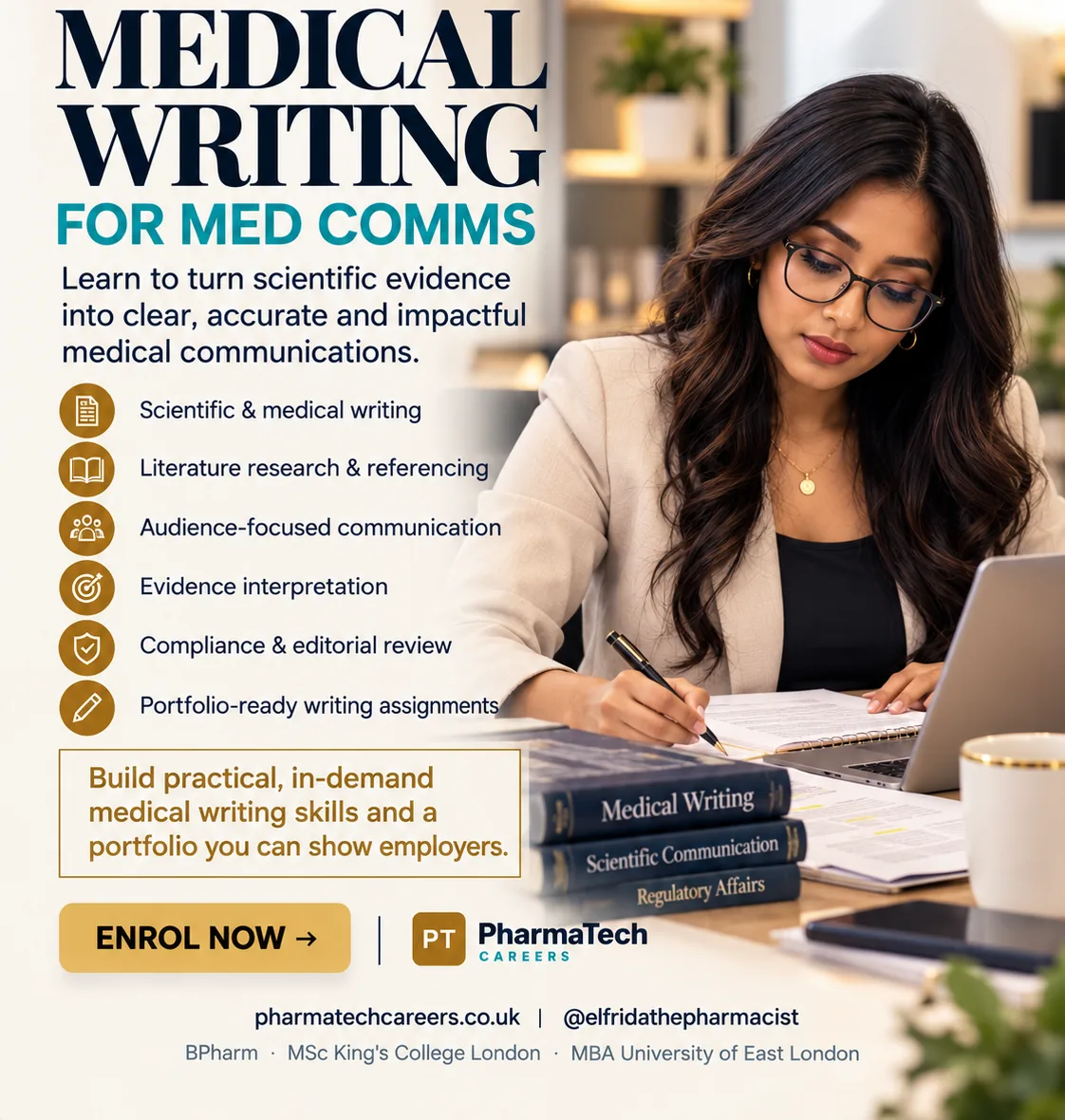
Learn how to turn complex scientific and medical evidence into clear, accurate communication, and build work that demonstrates your writing capability.
Buy only the module you need. Each module below is a standalone self-directed learning product, and you can purchase it again whenever you need to revisit it.
Understand the Medical Writing profession, common career routes and the differences between regulatory, scientific, educational and medical communications writing.
Learn how purpose, tone, terminology and level of detail change when communicating with healthcare professionals, patients, regulators and scientific audiences.
Develop a structured approach to finding credible evidence, selecting appropriate sources and maintaining traceability between claims and references.
Learn to interpret study design, results, limitations and clinical relevance before turning research into written communication.
Organise complex information into a logical narrative while maintaining scientific accuracy and avoiding unsupported conclusions.
Build professional habits around citation, source verification, reference accuracy and ensuring that written claims are supported by evidence.
Practise extracting relevant findings from research papers and converting them into concise, accurate scientific communication.
Learn to identify ambiguity, unnecessary language, inconsistency, unsupported claims and scientific or referencing errors.
Translate complex medical information into accessible language without losing accuracy or meaning.
Explore evidence-based writing for websites, professional education and digital healthcare communication while maintaining scientific standards.
Learn how to use AI responsibly for research support, planning, drafting, editing and quality review without outsourcing scientific judgement. Covers source verification, confidentiality, hallucinations, authorship integrity, bias and human accountability.
Prefer the complete career-transition route?
This is where knowledge becomes evidence. The Live Integration Programme is not a bundle of e-learning modules. It is the applied career-transition route, built for professionals who are ready to be taken seriously by UK employers: live teaching, case-based work, expert feedback, evidence building and hands-on support translating your new capability into the job market.
Selected work that meets PharmaTech Careers’ editorial standard may be considered for publication under the participant’s own professional author profile. Publication is selective and is not guaranteed.
You learn the way the industry works: through cases. You work real writing briefs to the standard a UK employer expects, so your first day in the role is not your first time doing the work.
Your work is reviewed and returned with feedback, so you know exactly where you stand, what is strong and what to fix before an employer ever sees it.
When a recruiter asks who can speak to your ability, you will have an answer. We provide references for our students on request, grounded in the casework you have completed with us.
Your new capability is translated into your CV, LinkedIn, portfolio and interview story, so employers see the evidence before you walk into the room.
Outcome
Develop professional Medical Writing capability and create work you can use to demonstrate that capability to employers.
Weekly job updates
Subscribe to the PharmaTech Careers newsletter and get weekly job updates straight to your inbox.
After you graduate
Medical Information, Pharmacovigilance and Medical Writing professionals work across pharmaceutical companies, contract research organisations and specialist safety and communications providers, including organisations such as these.
Company names are shown only as examples of organisations that employ professionals in these fields. PharmaTech Careers is not affiliated with, endorsed by or partnered with any organisation named.