Case-based work, not theory
You learn the way the industry works: through cases. You work realistic safety cases to the standard a UK employer expects, so your first day in the role is not your first time doing the work.
CPD accredited programme
Develop a practical understanding of how medicine safety information is identified, processed, assessed and monitored across the Pharmacovigilance lifecycle.
Pharmacovigilance Specialist Programme · The CPD Standards Office · Provider 51119 · 2026 to 2027

Buy only the module you need. Each module below is a standalone self-directed learning product, and you can purchase it again whenever you need to revisit it.
Understand why Pharmacovigilance exists, the purpose of drug-safety systems and how PV teams operate within pharmaceutical organisations.
Follow an Individual Case Safety Report (ICSR) from receipt and validation through processing, follow-up, quality review and regulatory submission.
Learn the minimum criteria for a valid case, recognise potential safety information and understand the first decisions made when a report enters the safety system.
Understand the principles used when assessing safety cases and practise distinguishing the concepts through realistic examples.
Introduction to the Medical Dictionary for Regulatory Activities (MedDRA), coding principles and why consistent terminology matters in global safety data.
Learn how to organise clinically relevant information into a clear, chronological and medically meaningful safety narrative.
Identify information gaps in safety cases, determine what additional information is needed and develop appropriate follow-up questions.
Understand how scientific and medical literature contributes to case identification and ongoing safety surveillance.
See how individual safety reports contribute to wider safety monitoring, signal management and ongoing benefit-risk evaluation.
Understand the principles behind UK and international PV requirements, documentation, reporting timelines, data quality and inspection readiness.
Explore responsible AI and automation across case intake, information extraction, coding support, literature surveillance and safety-data review, with emphasis on validation, privacy, bias, traceability, human oversight and regulatory accountability.

Prefer the complete career-transition route?
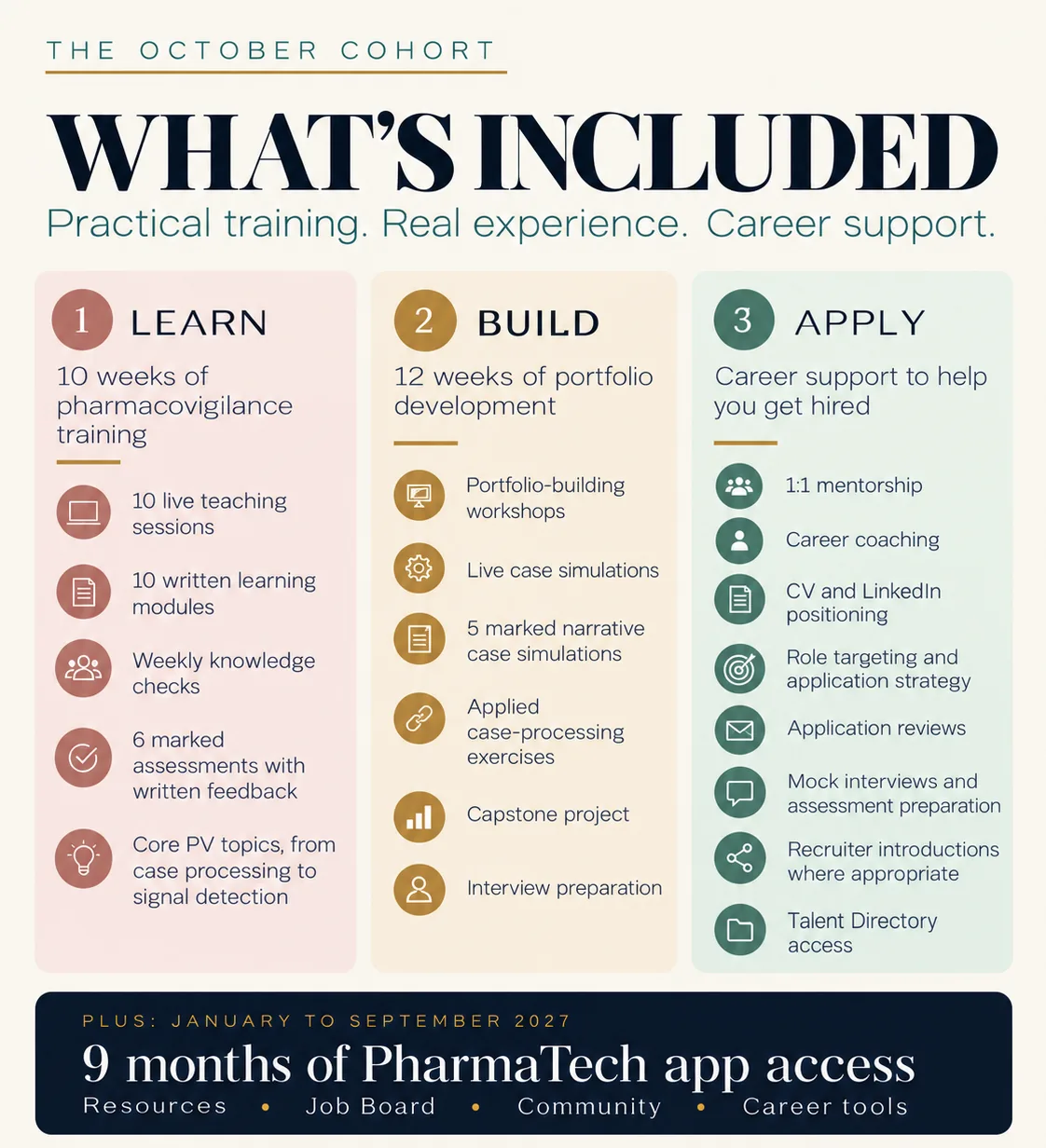
Train. Build evidence. Get hired. This is where knowledge becomes evidence. The Live Integration Programme is not a bundle of e-learning modules. It is the applied career-transition route, built for professionals who are ready to be taken seriously by UK employers: live teaching, case-based work, expert feedback, evidence building and hands-on support translating your new capability into the job market.
You learn the way the industry works: through cases. You work realistic safety cases to the standard a UK employer expects, so your first day in the role is not your first time doing the work.
Your work is reviewed and returned with feedback, so you know exactly where you stand, what is strong and what to fix before an employer ever sees it.
When a recruiter asks who can speak to your ability, you will have an answer. We provide references for our students on request, grounded in the casework you have completed with us.
Your new capability is translated into your CV, LinkedIn, portfolio and interview story, so employers see the evidence before you walk into the room.
Resources, Job Board, Community and Career tools, all in one place for programme members.
Outcome
Understand the safety case lifecycle and practise the core activities you will need to explain and apply when competing for Pharmacovigilance roles.
Weekly job updates
Subscribe to the PharmaTech Careers newsletter and get weekly job updates straight to your inbox.
After you graduate
Medical Information, Pharmacovigilance and Medical Writing professionals work across pharmaceutical companies, contract research organisations and specialist safety and communications providers, including organisations such as these.
Company names are shown only as examples of organisations that employ professionals in these fields. PharmaTech Careers is not affiliated with, endorsed by or partnered with any organisation named.